Posts

Showing posts with the label Art/Reviews

THE VAN GOGH BRAND

Image
VAN GOGH IN BRITAIN AT THE TATE MODERN*  So many people visited the Van Gogh exhibition that restitution had to be sought from the Arts Council for damage to the gallery flooring. That was in 1947, the last time London hosted a major Van Gogh exhibition.   The famous Dutch painter was, to put it mildly, a crowd puller. And indeed no sooner had the current exhibition at Tate Britain opened than it sold out. Crowds queue to view the pictures then crowd into the galleries, seeking to get a reasonable view of the paintings amidst the milling mass of eager consumers. Until, as a woman stated standing close by to her friend, “these then are the famous sunflowers.   And indeed, they were, in all their glory, so that you could almost smell the pungent aroma coming from their dark hearts. The Van Gogh ‘brand’ encapsulated? There is also, of course, the madness, the odd business with the ear, the melancholy of the self-portraits and more recently the accompanying song... ...
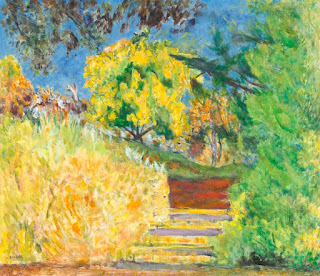
BEHIND BRIGHT COLOURS

Image
Pierre Bonnard at The Tate Modern  Stairs to The Garden 1942 Pierre Bonnard I looked forward to seeing the Bonnard  exhibition at the Tate Modern, however, whilst there is much to enjoy, I left with a strange feeling of claustrophobic melancholy. Something about the exhibition seemed sad and forlorn, more so owing, perhaps, to Bonnet’s reputation.    Pierre Bonnard, painter of domestic harmony, of glorious landscapes and gardens that assault the eye with bursting shells of colour, exploding yellows and reds, crimson and blue; the happy painter who through two world wars and the troubled inter-war years continued to paint pictures that depicted not only visions of intimate domesticity but the contentment of a settled life which had a love of beauty at its heart. The Belle Époque is perhaps the most burnished period in modern history.  This I suspect is a consequence as much of the cultural, scientific and artistic triumphs of the period as the mann...

TANNING AT THE TATE

Image
REFLECTIONS ON SURREALISM  It is difficult to believe but we will soon be approaching the hundredth birthday of Surrealism, child of DADA and Freud, the most famous art movement of the 20 th Century. From advertising to comic books and movie posters surrealist images are ubiquitous and ingrained into the culture. What precocious teenager did not have an Athena Salvador Dali poster on their wall? For a taste for surrealism was a short cut to showing that you were ‘deep’ and ‘arty.’ Iconic Dali Image It’s very success was its greatest failure, when images adorn every Tube station platform or magazine advert they cease to be original, let alone shocking. So, it was with mixed feelings that I approached the Dorothea Tanning exhibition at the Tate. Volkswagon Advertisement Given the rampant sexism that even now characterises the art world, it is perhaps understandable, if unforgivable, that I had only ever heard of Tanning as the wife of Max Ernst so that her work wa...

THE TICKING CLOCK

Image
‘Time, he's waiting in the wings.  He speaks of senseless things.  His script is you and me, boys’ 'Time'  David Bowie Time is the most fascinating of all aspects of existence so that any exploration of the subject from Proust to HG Wells is bound to fascinate. Time is what we are born into, the place where we live, the stage on which we act out the drama of our lives. Time is invariably the boss, it removes beauty and agility, brains and brawn and, or so it feels, slips away ever faster just as we realise how precious it is. We live in it but cannot grasp it or make it change direction.  Time is dying is dissolving as we breath, it is constantly slipping through our fingers.  We are not killing time; time is killing us. Twenty four hours, as James Joyce, Malcolm Lowry and others have depicted, can represent a lifespan, and twenty-four hours is the subject of Christian Marclay’s installation at the Tate Modern . simply entitled 'Clock.'  Cons...

WHEN THE POSTER WAS KING

Image
Paddington Printshop produced posters for the burgeoning squatters rights movement, for community resources, and for acts of social and political activism in the centre of London in the mid-1970’s for over a decade…. The posters are visually striking examples of silkscreen and stencil printing at its most vibrant.’ Boo-Hooray, NY Art Book Fair, 2017 edition. I n the age of social media and the Internet we face a daily barrage of urgent and demanding communication, sign this petition, support this cause, retweet, follow us, adopt this hashtag. Politicians and political campaigns seek to grab our attention either by softly imploring or shouting in our face. All this in less than twenty years. Before this, there was only the leaflet, direct mail, and, of course, the poster. This exhibition at the London print studio allows you to travel back in time and enter the age of community activism in North West London, the age of the poster . The idea that the sixties ceased at mi...

CANALETTO AND THE WALLACE COLLECTION

Image
Is viewing paintings more than a comfort, a way of plugging into a wider, deeper, more profound perspective during troubled times, or is it merely escapism? I found myself thinking these thoughts the other week as I stood before one of the Canaletto’s in the Wallace Collection. These are magnificent pictures that can, if you stand still, focus and absorb the Venetian scene, the placid water and the active inhabitants, transport you back to early 18 th Century Venice. For moments on end I was mesmerised and as we left the gallery and later, as my friend and I sat in the cafe on the ground floor, I felt somehow different about Brexit, Donald Trump and the gloomy international prognosis.  In what way ‘different’ it was hard to pin down, perhaps it was no more than having glimpsed another world, in which these concerns were not only absent but incomprehensible.  It was an emotion akin to envy, - most certainly misplaced, - of a simpler better age and a more profoun...

IN THE GALLERY

Image
‘Painting with Light’ Art and Photography from the Pre-Raphaelites to the modern age Tate Britain: Exhibition 11 May – 25 September 2016 I. Looking at paintings, sculpture, drawings, in short absorbing ‘art’ exhausts me. After about thirty minutes I need to sit down. And so I now sit on a bench in the Tate Britain and close my eyes. An image, a woman’s face, is planted there, a delicate pre-Raphaelite face, pursed lips, and intense unforgiving eyes.  I knew those eyes well, they were Z’s eyes cold as ice in the face of some real, or imagined, -much more frequently imagined, -infidelity on my part. In the gallery, strangers mingle and talk in lowered voices as if at a garden party thrown by the Queen. But in this filtered atmosphere ghosts flit silently amongst the crowd or stare down from canvases as they engage endless critics and admirers. I do not really fear these ghosts; indeed, it is these very ephemeral phantoms with whom I have come to talk; but I always...

ALGERIANISM

Image
This is a slightly amended review written for The Nour Festival Blog ALGERIANISM Patrick Altes Algerianism, if considered at all, in this country tends to be conceptualised as coming in a box marked pied noir, - often wrongly associated with the work of Albert Camus. The French rather than Algerian element taking precedence. This Exhibition however represents a confident exploration by Algerians seeking to explore their own complex identity, though the ghosts of French occupation, colonial presence and influence on Algerian culture is very much present as well.  Now of course the idea that Algeria and metropolitan France were as one was not only absurd but also camouflaged the reality of French imperialism, racism and brutality. That said the French presence in Algeria introduced a unique element into Algerian culture, and it is the ghost of this presence that haunts the pictures of Patrick Altes, a French artist, in which images of the past and present are fused t...